1Department of Rachana Sharira, Nootan Ayurvedic College & Research Centre, Sankalchand Patel University, Visnagar, Gujarat, India
2Department of Rachana Sharira, Sardar Ayurved College, Gujarat Ayurved University, Piludara, Mehsana, Gujarat, India
3Department of Rachana Sharira, PP Savani Ayurvedic College and Hospital, Surat, Gujarat, India
4Department of Anatomy & Plastination Lab-in-Charge, Travancore Medical College, Kollam, Kerala, India
Plastination in India is currently in its primary stages of development, facing challenges related to infrastructure and specialized expertise. However, indigenous medical streams, particularly Ayurveda, are increasingly recognizing the vital importance of plastination for enhancing medical education and translational research. This report outlines a National Workshop funded by the Department of Health Research (DHR), Ministry of Health & Family Welfare, held at Nootan Ayurvedic College & Research Centre. The event served as a critical platform for promoting plastination methods among academic faculties and demonstrated how government support and institutional collaboration are successfully bridging the gap between traditional anatomical study (Rachana Sharira) and modern preservation technology.
ayurveda; dhr-icmr; indigenous medicine; medical education; plastination in India; rachana sharira; translational research
Dr Pragalbh MR, Organizing Secretary & Associate Professor, Department of Rachana Sharira, Nootan Ayurvedic College & Research Centre, Visnagar, Gujarat, India
Email: drpragalbh@gmail.com





While plastination has revolutionized anatomical preservation globally, in India the field remains in its early stages. Its widespread adoption has historically been hindered by technical barriers and high initial costs. Despite this, a paradigm shift is occurring within Ayurveda and other indigenous medical streams. Scholars of Rachana Sharira (anatomy) have identified plastination as a superior alternative to traditional formalin-based preservation, offering odorless, non-toxic, and durable specimens essential for high-fidelity clinical training (Henry, 2007).
Since its introduction by Gunther von Hagens in the late 1970s, plastination has achieved widespread global adoption across premier medical and veterinary institutions, transforming from a novel preservation technique into a standard pedagogical tool (von Hagens et al., 1987). Developed nations have progressively institutionalized the practice to replace deteriorating cadaveric materials and mitigate the health hazards of volatile organic compounds in dissection halls (von Horst et al., 2019). Beyond its immediate educational utility, modern plastination carries profound implications for sustainable medical and laboratory practices (Jones, 2002). By yielding highly durable, biologically stable, and virtually indestructible specimens, it drastically curtails the continuous, long-term consumption of chemical fixatives such as formaldehyde, which is classified as a known human carcinogen (International Agency for the Research on Cancer, 2012). Consequently, transitioning to plastination represents an eco-friendly milestone that minimizes hazardous chemical waste disposal while optimizing institutional resources over time.
Recognizing this potential, the Government of India, via the Department of Health Research (DHR), is actively promoting these methods. By providing funding and technical oversight, the government is enabling institutions to establish the foundations of a national plastination network.
SCIENTIFIC PROGRAM
The workshop, conducted on September 29th–30th, 2025, provided a structured immersion into plastination workflows. The curriculum was specifically tailored to address how these techniques can be integrated into the Ayurvedic academic framework.
PARTICIPATION AND INSTITUTIONAL COLLABORATION
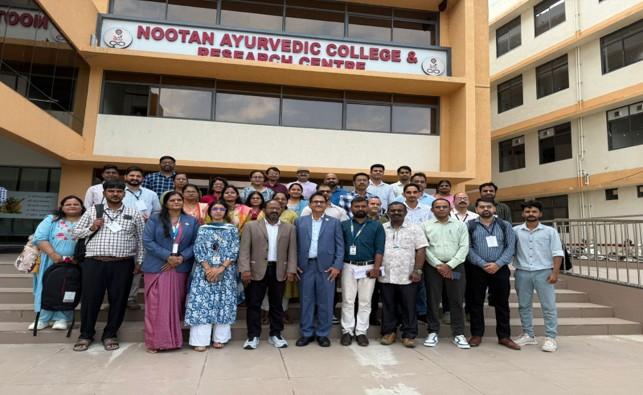
Figure 1. Participants and resource persons during the practical session of the "Two-Day National Workshop on Plastination Techniques" at Nootan Ayurvedic College & Research Centre
The event drew 30 academic faculty members (19 males, 11 females) from across India, including Gujarat, Karnataka, Rajasthan, Uttar Pradesh, Maharashtra, and Kerala (Fig.1). This diverse participation reflects a nationwide interest in moving beyond the "primary stage" of plastination. The collaboration between Sankalchand Patel University and the DHR served as a model for how institutional resources and government funding can combine to foster innovation in medical education.
WORKSHOP ACTIVITIES
The workshop utilized a "Demonstration-Observation-Assistance-Performance" (DOAP) model.
Key hands-on activities included:
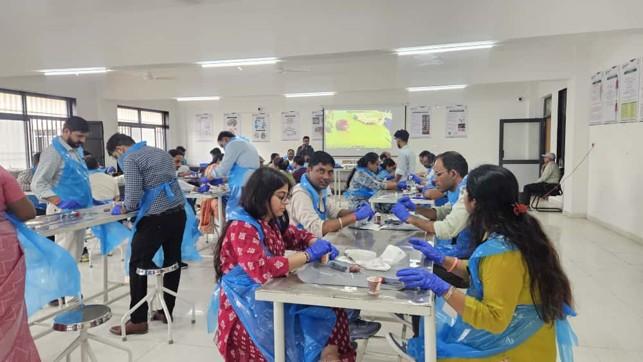 Figure 2. This image demonstrates the collaborative environment between DHR representatives and Ayurvedic faculty members as they engage in the primary stages of anatomical specimen preparation |
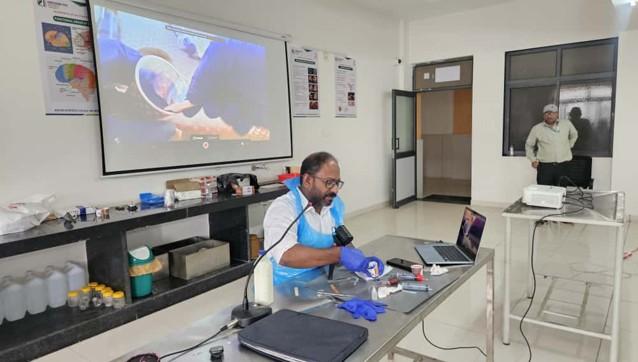 Figure 3. Expert resource person demonstrating the precision-driven steps of silicone forced impregnation to faculty participants during the DHR-funded national workshop. The session emphasized the importance of controlled vacuum pressure in achieving high-quality anatomical specimens for translational research. |
EVALUATION OF THE DOAP PEDAGOGICAL MODEL
To validate the structural efficacy of the DOAP model, a structured post-workshop evaluation was conducted among the 30 faculty participants. Performance metrics and experiential feedback were gathered via a validated 5-point Likert scale questionnaire, focusing on skill acquisition, confidence levels, and conceptual clarity (Table 1).
|
Evaluation Metric (DOAP Validation) |
Mean Score (Out of 5) | Agreement/ Success Rate (%) |
| Clarity of Technical Demonstrations (D) | 4.82 | 96.4% |
| Sufficiency of Guided Observation (O) | 4.65 | 93.0% |
| Effectiveness of Hands-on Assistance (A) | 4.78 | 95.6% |
| Confidence in Independent Performance (P) | 4.43 | 88.6% |
| Relevance to Ayurvedic Anatomy Teaching | 4.90 | 98.0% |
The performance metrics revealed that while theoretical comprehension and collaborative processing scored exceptionally high, independent execution under vacuum pressure (P) represented the steepest learning curve, highlighting the necessity for continuous institutional mentorship. Overall, 94% of the participants strongly agreed that the DOAP model was superior to conventional passive lecturing for laboratory-intensive workflows.
The current state of plastination in India remains in its early stages, largely due to the high cost of specialized polymers and the technical complexity of setting up dedicated laboratories. However, this workshop demonstrated that indigenous medical streams, particularly Ayurveda, are uniquely positioned to spearhead the adoption of these methods. In the study of Rachana Sharira (anatomy), the transition from traditional formalin-preserved specimens to plastinated models addresses critical challenges regarding specimen durability and the health hazards associated with long-term chemical exposure.
The global trajectory of plastination underscores its role not merely as a luxury teaching aid, but as a core component of sustainable, bio-safe medical education frameworks (Jones, 2002). By eliminating recurrent exposure to toxic formalin vapors, adopting institutions align themselves with global green laboratory initiatives (GLIs). The proactive involvement of the Department of Health Research (DHR) and the Ministry of Health & Family Welfare marks a significant turning point, providing the necessary financial framework to move these technologies into the mainstream.
By utilizing the DOAP pedagogical model (Sundeep & Pillai, 2020), the workshop successfully built technical capacity among 30 faculty members. The objective performance metrics and highly positive participant feedback confirm that high-standard silicone and sheet plastination can be effectively executed within an Ayurvedic institutional framework. The strong success rates in
step-by-step performance validation prove that the DOAP framework bridges the gap between passive learning and high-precision technical mastery. This collaborative approach between government bodies and academic institutions not only promotes modern preservation techniques but also enhances translational research opportunities, allowing for a more sophisticated clinical understanding of traditional anatomical concepts.
The successful execution of this DHR-funded workshop confirms that while plastination in India is in its infancy, the momentum provided by the government and the enthusiasm of the Ayurvedic community are driving it forward. By moving away from traditional chemical preservation and utilizing optimized training pathways like the DOAP model, Indian medical education is poised to provide a safer, more sustainable, and technologically advanced learning environment.
ACKNOWLEDGMENTS
The organizing committee extends its sincere gratitude to the Department of Health Research (DHR), Ministry of Health & Family Welfare, for their financial support, and to the leadership of Sankalchand Patel University for fostering a culture of research and innovation.
Henry RW. 2007: Silicone plastination of biological tissue: Cold-temperature Technique Biodur© S10/Sl5 Technique and Products. J Int Soc Plastination 22:2-14. https://doi.org/10.56507/ZLMJ7068
International Agency for the Research on Cancer (IARC) 2012: Monograph 100F: Formaldehyde. In: A Review of Human Carcinogens: Chemical Agents and Related Occupations: Lyon, France: WHO
Jones DG. 2002: Re-inventing anatomy: The impact of plastination on how we see the human body. Clin Anat 15(6): 436–440. https://doi.org/10.1002/ca.10040
Sundeep S, Pillai SK. 2020: Demonstrate observe assist perform versus video assisted teaching in teaching deep tendon reflexes to medical students: a comparative study. Int J Res Med Sci 8:613-7. DOI: http://dx.doi.org/10.18203/2320-6012.ijrms20200244
von Hagens G, Tiedemann K, Kriz W. 1987: The current potential of plastination. Anat Embryol 175(4): 411–421
von Horst C, von Hagens R, Sora C-M, Henry RW. 2019: History and development of plastination techniques. Anat Histol Embryol 48(6):512-517 https://doi.org/10.1111/ahe.12497

